What If You Built Your Next Business in El Salvador?
From an Idea to a Brand, a Launch, and a Future
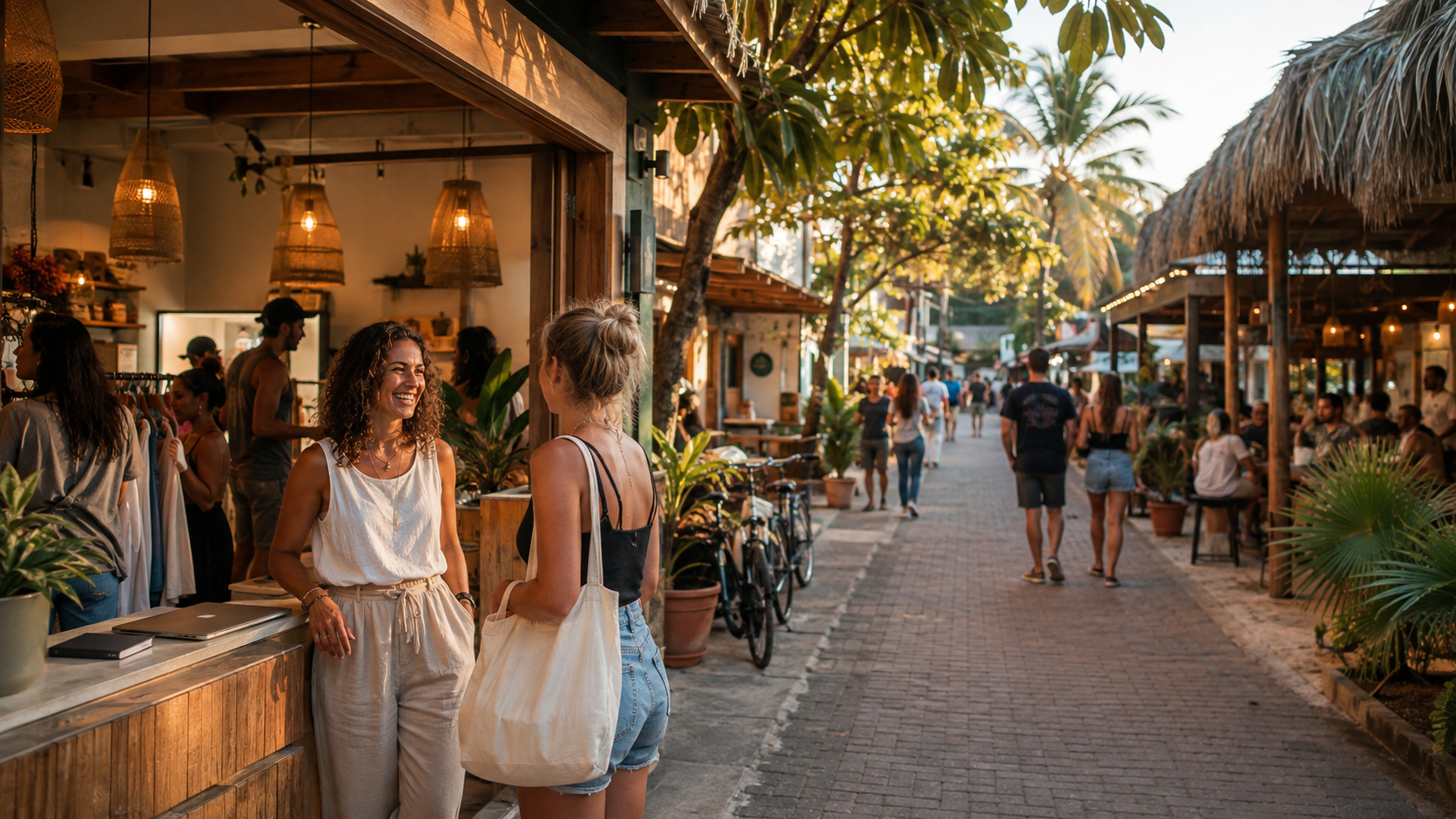
Picture a busy afternoon in El Tunco.
People walk along the main street looking for somewhere to eat, something to experience or a place that catches their attention. Music comes from nearby restaurants. Travelers, residents and entrepreneurs share the same vibrant coastal community.
Among the cafés, shops and tropical storefronts, one business is different.
It is yours.
Customers are walking in. Your team knows what to do. The atmosphere reflects the idea you once had only in your imagination. The laptop is finally closed — not because the work is over, but because the plan has become something real.
This is not simply about opening a business in another country.
It is about recognizing an opportunity, building the right concept around it and creating something that supports the life you came to El Salvador to enjoy.
Start With the Opportunity, Not the Logo
A business rarely begins with a name or a color palette. It begins with noticing something.
Perhaps you visited a community and realized that a particular service was missing. Maybe you saw growing demand for a better dining experience, specialized accommodation, wellness concept, retail store, professional service or tourism-related business.
Sometimes the opportunity comes from something you already know how to do. Other times, it appears through conversations with residents, travelers and local business owners.
The first question is not:
What should the business look like?
The first question is:
What problem will it solve, and for whom?
A promising idea connects three elements:
- A real need or desire.
- A clearly defined customer.
- A product or service people are willing to pay for.
An idea may feel exciting, but excitement alone does not make it viable. Before investing in a location, equipment or advertising, the opportunity must be understood.
Validate the Idea Before Building Around It
Validation means looking for evidence that the business can work before committing your full budget.
Who would buy the product? How frequently would they buy it? What alternatives do they already have? Is the demand consistent throughout the year, or does it depend heavily on tourism and high season?
A concept designed for El Tunco may require a different strategy from one created for San Salvador, Santa Ana or a developing mountain destination. Each market has its own customer behavior, operating rhythm, price expectations and competitive environment.
Validation may include:
- Speaking with potential customers.
- Observing traffic and activity at different times.
- Testing a simplified version of the product.
- Comparing locations.
- Reviewing similar businesses.
- Estimating realistic operating costs.
- Understanding seasonal changes in demand.
- Identifying what would make the concept different.
The purpose is not to eliminate every risk. No new business can offer that guarantee.
The purpose is to replace assumptions with information.
Understand the Market and the Competition
Competition is not automatically a negative sign. In many cases, it confirms that a market exists.
The real question is whether your business can offer a clear reason for customers to choose it.
If several cafés already operate in the same area, perhaps the opportunity is not another generic café. It might be a stronger breakfast concept, a distinctive product, better service, a more memorable atmosphere or an experience designed for a specific audience.
Market research should examine more than competitors' social media accounts. It should consider:
- Their location and visibility.
- The customers they attract.
- Their products and price ranges.
- Their busiest and quietest periods.
- Their online reviews.
- The strengths customers repeatedly mention.
- The frustrations or unmet needs people describe.
- The experience before, during and after the purchase.
The objective is not to copy what already works. It is to understand the landscape well enough to build something with its own position in the market.
Turn the Opportunity Into a Brand
Once the concept has been validated, the business needs an identity capable of communicating its value.
A brand is more than a logo. It is the complete impression created by the name, message, visual language, products, environment, service and customer experience.
Before designing anything, the business should be able to answer:
- Who are we serving?
- What are we offering?
- Why does it matter?
- Why should someone choose us?
- How should people feel when they encounter the brand?
- What should they remember afterward?
From those answers, the visual and verbal identity can be developed with purpose.
The name, colors, typography, photography and tone should work together. A beach business may feel relaxed without becoming careless. A premium service may feel sophisticated without appearing inaccessible. A local concept can celebrate El Salvador without relying on predictable clichés.
The strongest brands do not simply look attractive. They make the business easier to understand and remember.
Build the Right Product — and Price It Correctly
A great idea can still fail if the product is confusing or the pricing is disconnected from reality.
The product or service must be shaped around the customer while remaining financially sustainable for the business.
That involves understanding:
- Direct product or service costs.
- Rent and utilities.
- Salaries and professional services.
- Equipment and maintenance.
- Taxes, permits and administration.
- Marketing and sales costs.
- Seasonal fluctuations.
- The margin required for the business to grow.
Pricing should not be based only on what competitors charge. Your operation, quality, experience and target customer may be different.
The objective is not necessarily to be the cheapest option. It is to create a price that customers can understand and that allows the business to deliver its promise consistently.
Find a Location That Supports the Concept
The right location can strengthen a business. The wrong one can make every other part more difficult.
A beautiful space is not enough. The property must match the operation.
A retail store may need pedestrian traffic and visibility. A restaurant must consider kitchen requirements, ventilation, water, waste management and supplier access. A wellness retreat may prioritize privacy, atmosphere and accessibility. A professional service may need convenience, parking and proximity to its customers.
Through Homeland, the location search can become part of the business strategy rather than a separate decision.
Depending on the concept, this may involve:
- Finding an existing commercial space.
- Renting before committing to a purchase.
- Buying a property.
- Identifying land for development.
- Remodeling an existing building.
- Coordinating repairs and improvements.
- Evaluating beach, mountain or city locations.
Marketianding develops the business concept. Homeland helps find the place where it can live.
Together, the brand and the location become part of the same vision.
Prepare the Launch Before Opening the Doors
A launch should begin before the first customer arrives.
The business needs to know what will be ready, what still needs testing and how people will discover it.
A practical launch plan may include:
- A clear opening offer.
- Product photography and branded content.
- Google Business Profile preparation.
- Website or landing page publication.
- Social media content.
- Local collaborations.
- Staff training.
- A soft opening to test operations.
- Customer feedback and early reviews.
- Promotional campaigns for the official launch.
Opening day should not be the first time the business discovers how customers respond.
A controlled soft launch creates room to correct pricing, service, presentation and operational problems before marketing reaches a larger audience.
Build a Digital Presence That Keeps Working
A physical business may operate from one location, but its first interaction with many customers will happen online.
Someone may discover the brand through Google, Instagram, a recommendation, an online article or a paid advertisement. What they find should create confidence and make the next step easy.
That digital foundation can include:
Website
The website should explain what the business offers, where it is located and why it is worth choosing. It must work properly on mobile devices and guide visitors toward an action — making a reservation, sending a message, requesting information or visiting the location.
SEO
Search engine optimization helps the business become discoverable when people are actively looking for its products or services. This includes technically sound pages, useful content, appropriate keywords, accurate local information and a structure that search engines can understand.
Social Media
Social media should reveal the experience behind the brand, not simply repeat promotional messages. Products, people, stories, customer moments and the surrounding community can all help create familiarity and trust.
Advertising
Paid campaigns can accelerate visibility, but advertising works best when the concept, message, offer and customer journey are already clear.
More traffic will not repair a confusing business. It will only expose the confusion to more people.
Strategy must come first.
Build a Business That Supports Your Life
Success should not mean moving to El Salvador only to recreate the same exhausting life you wanted to leave behind.
The purpose of building a business is not simply to remain busy. It is to create something sustainable — something that can grow, employ people, serve customers and give you the freedom to experience the life you imagined.
That requires systems, clear responsibilities, reliable partners and a brand that can continue working even when you close the laptop.
The image of the successful business on a lively street does not begin with opening day. It begins with the opportunity, the research, the decisions and the work that happened before anyone saw the final result.
The storefront is only the visible part.
Behind it is a strategy.
Let's Make It Real
You may already have a complete idea. You may have noticed an opportunity but do not know how to develop it. You may need a name, a brand, a website, a location or a complete plan connecting everything.
The Marketianding Business Studio helps you organize those decisions and turn them into a practical path forward — from idea validation and market research to branding, pricing, location, launch, website, SEO, social media and advertising.
You do not need to arrive with every answer.
You only need to begin with the possibility.
What if the next business people discover in El Salvador is yours?
Use the Marketianding Business Studio and let's build it from the idea to the launch — and from the launch to the future.